

Every finance leader can tell you how many days their close will take. Ten. Eight. If they've invested well, six. What almost none of them can tell you is what happens in the hour after the books close — who saw the number first, who acted on it, and how fast that action turned into a decision.
That gap is the real cost. Not the close itself.
For years, "finance transformation" has been sold as a speed problem: shrink the close, automate the reconciliations, get the reports out faster. And that work matters — automation has cut close cycles from an average of 10 days down to roughly 6.4, according to recent close-automation research.
But speed alone doesn't change what finance is. A faster report that still sits in someone's inbox for three days before a decision gets made is just a faster bottleneck.
The organizations pulling ahead in 2026 have stopped treating finance as the function that reports what happened. They're rebuilding it as the function that orchestrates what happens next — a decision-orchestration layer, not a records department.
And the mechanics of that shift are happening inside Dynamics 365 Finance right now.

Why "Faster Close" Was Always the Wrong Finish Line
Ask a CFO what keeps them up at night in 2026, and accuracy, not speed, tops the list. Recent industry research found that when finance leaders were asked what drives their automation strategy, the majority pointed to data accuracy over efficiency or cost savings.
That's telling. It means the old scoreboard (close days, headcount saved) is being replaced by a harder question: can finance be trusted to hand a decision-maker a number they can act on immediately, without a second round of verification?
Most legacy close processes can't answer yes. Reconciliation alone can eat 10–15 days of a close cycle when it's manual, and manual data entry still carries a real error rate — enough that one incorrect line item can quietly undo the trust an entire report depends on.
Multiply that friction across every legal entity, every intercompany elimination, every variance that needs a human explanation, and finance ends up spending its month explaining the past instead of shaping the next quarter.
That's the stakes. Every day the close stays open is a day leadership runs the business on numbers that are already out of date. And in a market where more than half of CFOs now call AI-agent integration a top 2026 transformation priority, "stale but accurate" isn't a good enough trade-off anymore either. The bar has quietly moved from "can we trust the number" to "can we act on the number the moment it lands."
The 98% Problem: Everyone's Automating, Almost No One's Deciding Faster
Here's the uncomfortable statistic sitting underneath most finance transformation conversations right now: nearly every CFO says their team has invested in some form of digitization or automation. And yet, by most leaders' own admission, less than a quarter of their finance processes are actually digitized end to end. Automation adoption has become close to universal. Automation depth hasn't.
That gap explains why so many finance teams feel like they've "done AI" and still don't feel faster where it counts. They've automated the parts that were easy to automate — a reconciliation here, an approval routing there — without ever connecting those automated steps into something a decision-maker can act on without stopping to double-check it. The tasks got faster. The decisions didn't.
This is exactly the distinction decision-orchestration is built to solve. It isn't a new tool bolted onto the close. It's a different question asked of every automated step: does this task, once completed, hand a human being something they can act on immediately — or does it just produce a cleaner version of the same bottleneck?
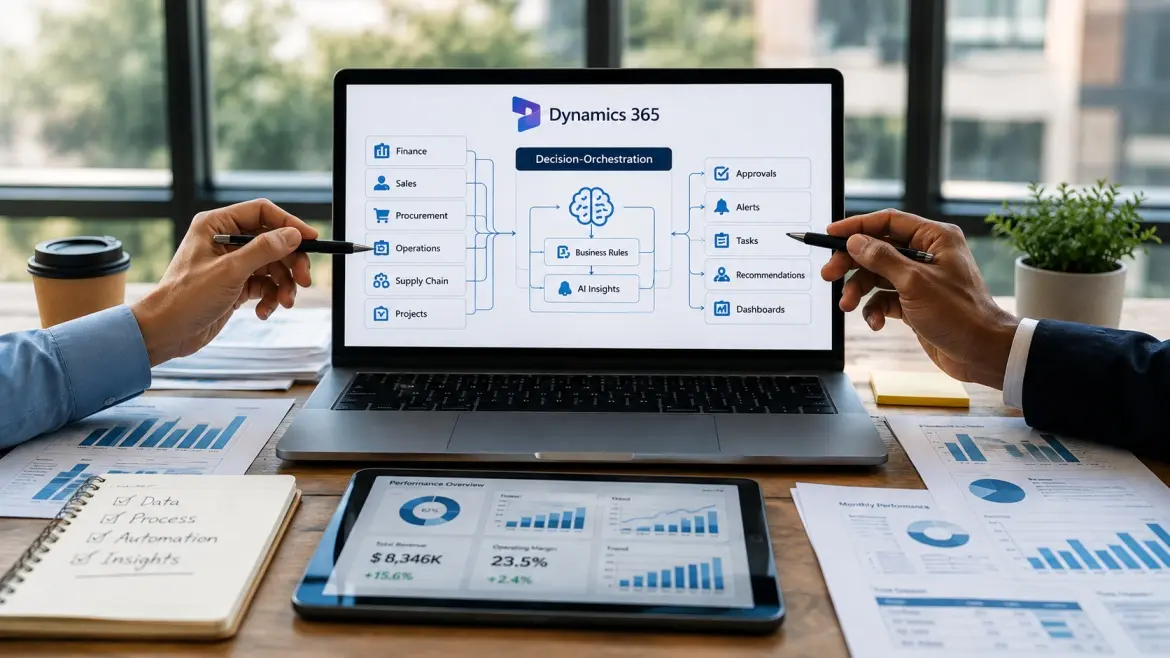
What Decision-Orchestration Actually Means Inside D365
Decision-orchestration isn't a rebrand of automation. It's a shift in what finance is optimizing for: not "did the task get done," but "did the right person get the right decision, at the right moment, with enough confidence to act on it without a follow-up meeting."
Inside Dynamics 365 Finance, this shows up in a specific pattern that Microsoft's own 2026 release wave was built around: exception-driven execution rather than blanket automation. The Account Reconciliation Agent closes out the routine, low-risk matches on its own.
Copilot's variance analysis compares actuals against budget and prior periods, surfaces the movements that actually matter, and drafts a data-backed explanation for them rather than leaving a controller to reverse-engineer it from a pivot table. What lands in front of a finance leader isn't a 40-tab spreadsheet — it's a short, ranked list of things that genuinely require a human judgment call.
That's the orchestration part. The system isn't replacing finance's decision-making authority, it's routing attention to where a decision is actually required, and clearing everything else out of the way.
On the collections side, this same pattern shows up as AI-generated account summaries and draft reminders — small time savings per account that compound into real hours once you multiply them across hundreds of open balances every single period.
Crucially, governance, approval gates, and audit trails stay firmly in place at every step. This is deliberately not "autonomous finance," and most finance leaders wouldn't want it to be.
It's finance with the noise removed — a system built so the people making judgment calls spend their time on the calls that actually need judgment.
From Touchless Close to Touchless Decisions
"Touchless close" has been the buzzphrase for a couple of years now. But a close that runs untouched and still dumps a static PDF on a CFO's desk hasn't actually changed the business — it's just automated the handoff to the same slow decision that followed it before.
The next layer, and the one actually worth building toward, is a close that feeds decisions directly into the workflows where they're made. A collections manager who gets an AI-drafted, ready-to-send reminder instead of a raw aging report.
A regional controller who gets a plain-language explanation of why margin moved, not just the number it moved by. A CFO whose board pack narrative is already assembled from the same data the close just produced, instead of being rebuilt by hand a week later.
This is where the return on investment actually lives. Straight-through processing and faster reconciliation are the visible wins, the ones that show up in a slide about "days to close." The compounding win is quieter: a finance team that spends its reclaimed time on judgment instead of data entry — reviewing exceptions, stress-testing forecasts, advising the rest of the business, rather than chasing bank statements and explaining variances after the fact.

Where This Breaks: The Governance Question Nobody Skips
It would be dishonest to write about decision-orchestration without naming the tension every serious finance leader raises the moment AI enters the close: how much authority is too much to hand to a system?
The honest answer, and the one reflected in how Microsoft has actually built its 2026 finance agents, is that approval gates and exception handling are enforced by design in the workflows that carry financial consequence. Reconciliation and variance analysis can run largely unattended. Journal postings, adjustments, and anything that touches financial controls still route through a human.
That's not a limitation to work around — it's the entire reason decision-orchestration is trustworthy in the first place. A close that moves fast but erodes control isn't progress, it's a new kind of risk wearing a faster interface.
The finance leaders getting this right treat automation like a portfolio decision rather than a blanket rollout: strengthen what's already proven, expand automation where the payback is clear, and scale AI specifically into the areas where governance and data quality have matured enough to support it.
That sequencing discipline is what separates a genuinely touchless close from a fragile one that breaks the first time an auditor asks a hard question.

What This Looks Like When It's Built Right
None of this happens by switching on a feature. It happens through deliberate configuration: which reconciliations are safe to automate first, which variance thresholds actually warrant a human review, how approval workflows are structured so speed never quietly erodes control, and which teams need a plain-language summary versus a full audit trail.
Get the sequencing wrong and you end up automating chaos faster — a close that runs untouched but produces numbers nobody fully trusts. Get it right, and every close cycle makes the next one shorter, because the system is learning where the real judgment calls live and routing everything else around them.
This is precisely the kind of Dynamics 365 Finance and Operations work that separates a technically correct implementation from one that actually changes how a finance team operates day to day — and it's where the right implementation partner earns their place at the table, not just at go-live.
It's less about switching on Copilot and more about deciding, deliberately, what finance should spend its newly freed time doing instead.
That's the Competitive Edge
A fast close is table stakes now — nearly every finance team is chasing it, and most will get there within the next few budget cycles. What separates the finance functions pulling ahead isn't close speed anymore. It's whether the numbers that come out of that close turn into decisions before the next meeting starts, instead of sitting in someone's inbox waiting for a second opinion.
If your close is fast but your decisions still lag behind it, the automation isn't the problem. The orchestration is missing.
If you're evaluating what a decision-orchestration approach to Dynamics 365 Finance could look like for your organization, Dynamics Monk's Microsoft Dynamics 365 consulting team works with finance leaders on exactly this shift — from close automation to close intelligence. Book a discovery call to see where your close cycle is losing decisions, not just days.