

Here's a sentence you've probably read six times this month: "Agentic AI is transforming CRM."
Microsoft is saying it. Every analyst is saying it. Your LinkedIn feed is saying it, usually with a stock photo of a robot handshake attached. And honestly? It's not wrong. Something real is happening inside Dynamics 365 right now, CRM is finally starting to act, not just sit there collecting stale data while sellers do the actual work by hand.
But here's the sentence nobody's writing, and it's the one that actually matters if you're the person signing off on the budget: agentic AI doesn't fix a broken implementation. It amplifies it.
If your D365 environment is a mess of over-customized fields, inconsistent data, and scope creep that ballooned your six-month project into a fourteen-month one, adding AI agents on top of that isn't a rescue mission. It's pouring a very expensive accelerant onto a fire you haven't put out yet.
Let's talk about both halves of this problem, because right now almost nobody is.
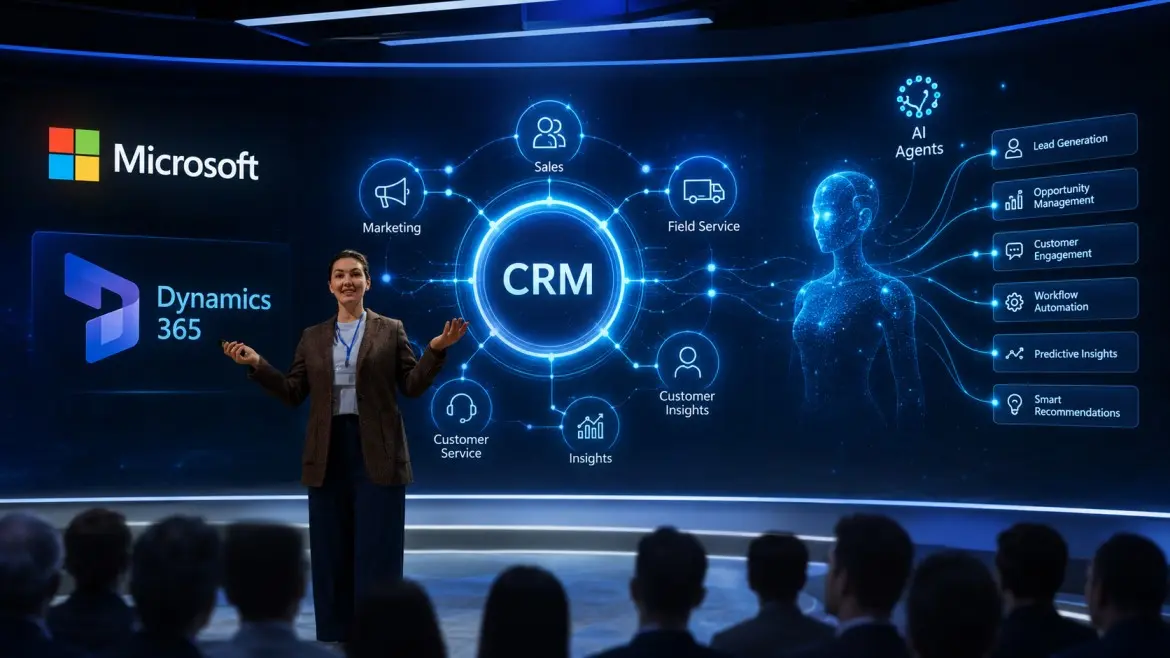
The Agentic CRM Moment Is Real, And Microsoft Is All In
Microsoft's own messaging has shifted hard in 2026. Their recent framing is blunt: for three decades, CRM has functioned as a rear-view mirror, a system built to record what already happened, not to act on it. That's the "CRM tax," the hours sellers lose to manual data entry, hunting for context across emails and chats, and updating records instead of talking to customers.
Agentic AI is supposed to close that gap. And the early numbers back it up. Microsoft's Sales Development Agent, tested internally across both Dynamics 365 and Salesforce, delivered a measured 15.1% lift in lead-to-opportunity conversion, not a projection, an actual production result. New capabilities rolling out through 2026, Data Entry Agents that populate CRM fields from pasted text or business cards, Data Exploration Agents that turn plain-language questions into filtered pipeline views, real-time voice agents that log notes automatically, are all aimed at the same target: getting sellers out of the CRM and back into the conversation.
This is genuinely useful technology. It's also genuinely oversold if the foundation underneath it isn't solid, and that's the part of the story that's getting skipped.

What's Actually Happening Inside Most D365 Budgets Right Now
While everyone's been talking about agents, a quieter, less flattering story has been playing out in implementation reviews across the industry. Recent 2026 benchmarking puts it plainly: 30–50% of Dynamics 365 projects experience delays or budget overruns, and the causes are almost never about the software itself. They're about poor data quality, unclear ownership, and integration complexity that nobody scoped properly on day one.
The financial gap is bigger than most stakeholders expect going in. Implementation services routinely run 3–5x the annual licensing cost on enterprise-grade deployments, and licensing is often only 15–25% of total first-year spend. The rest goes to configuration, customization, integrations, data migration, and the internal hours your own team burns on requirements gathering and testing, costs that rarely show up on the original quote.
And the single biggest reason projects blow past budget isn't a mystery. It's scope creep. A project scoped for standard functionality slowly accumulates custom workflows, one-off integrations, and "just one more field" requests until the six-figure estimate becomes something much larger, and much later.
Here's the Part That Connects Both Stories
This is where agentic AI and budget discipline stop being two separate conversations.
AI agents are only as good as the data and processes they're operating on. An agent that drafts a follow-up email, flags a stalled deal, or auto-populates a CRM record is reading from your Dataverse structure, your field definitions, your workflow logic. If that structure is inconsistent because of years of unmanaged customization, the agent doesn't get smarter around the mess, it just executes bad decisions faster and with more confidence.
Put another way: organizations that over-customize their D365 environment today aren't just paying for that complexity once, at implementation. They're going to pay for it again when they try to layer agentic AI on top, because standard, AI-native data flows are exactly what these agents are built to expect. The companies that stayed close to out-of-the-box functionality are the ones who'll onboard agentic features cleanly. The companies that customized heavily are looking at a second, quieter round of rework, this time to make their own system legible to the AI they were promised would save them time.
That's the real cost of a rushed or bloated implementation in 2026. It's not just the overrun you feel at go-live. It's the tax you'll pay again the moment you try to automate on top of a foundation that was never built to be automated.

How to Actually Get Ready for Agentic CRM
If you're planning a D365 implementation or upgrade this year, the sequence matters more than the speed.
- Scope before you sign: Define requirements in detail before engaging a partner, not during the project. Every "we'll figure it out as we go" decision is a future change order.
- Resist the urge to customize everything: Lean into standard functionality wherever the business case allows. Every custom field and workflow you add is something an AI agent will eventually need to work around, or something your team will need to strip out before agents can use the data cleanly.
- Fix your data before you migrate it: Duplicate records and inconsistent structures are the single most common failure trigger in D365 projects, and they're entirely preventable with a proper cleanup phase before go-live.
- Choose a partner who scopes like an advisor, not a vendor: The partner you choose affects your budget more than the software does. A partner with real industry experience will flag scope risk early instead of discovering it in month nine.
- Treat AI-readiness as a design requirement, not a bolt-on: If agentic CRM is on your roadmap for next year, say so during the current implementation. It changes how data structures and integrations should be built now.
The Takeaway
Agentic CRM is not a reason to move faster and looser on your D365 implementation. It's the opposite, it's the reason implementation discipline matters more than it ever has. The organizations that get real value from AI agents in 2026 and beyond won't be the ones who adopted first.
They'll be the ones who built a clean, disciplined foundation first and let the agents do what they're actually good at, instead of asking them to clean up a mess a rushed rollout left behind.
Thinking about a D365 implementation or upgrade this year? Talk to us about scoping a rollout that's built for both budget discipline and agentic AI from day one.