A business can outgrow its spreadsheets, outgrow its accounting software, and outgrow the processes that once made it efficient. But when it starts expanding into new companies, markets or product lines, another question appears: has it outgrown its ERP, or has the business simply become more complex to manage?
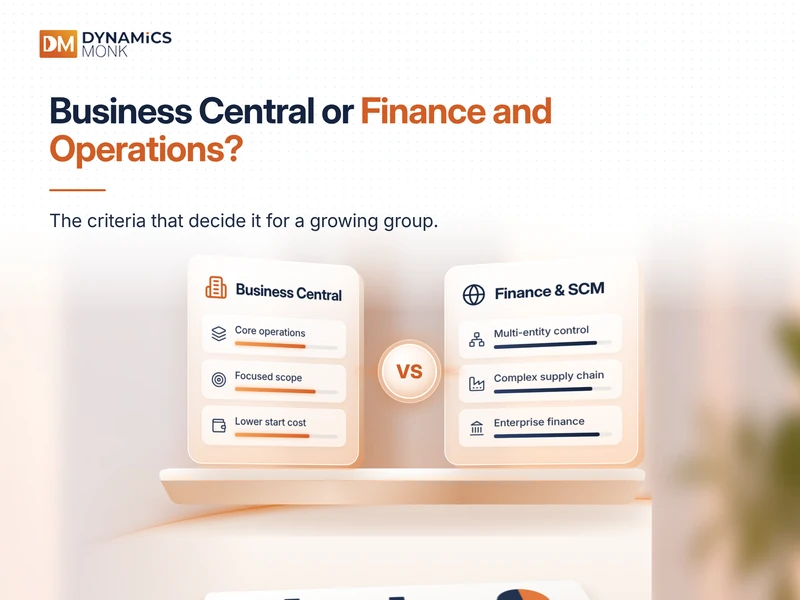
For organisations evaluating Microsoft Dynamics 365, this often leads to a choice between Business Central and Finance and Operations. Both support financial and operational processes, but they are designed for different levels and types of business complexity.
Choosing the right platform is not simply a matter of employee count or annual revenue. It requires understanding how the group manages its legal entities, financial reporting, supply chain, manufacturing, integrations and future expansion.
For technical consultants, functional consultants and software engineers, the distinction matters from the beginning. The ERP choice influences implementation design, data architecture, customisation, integrations, testing and long-term maintenance.
Business Central vs. Finance and Operations: What Is the Actual Difference?
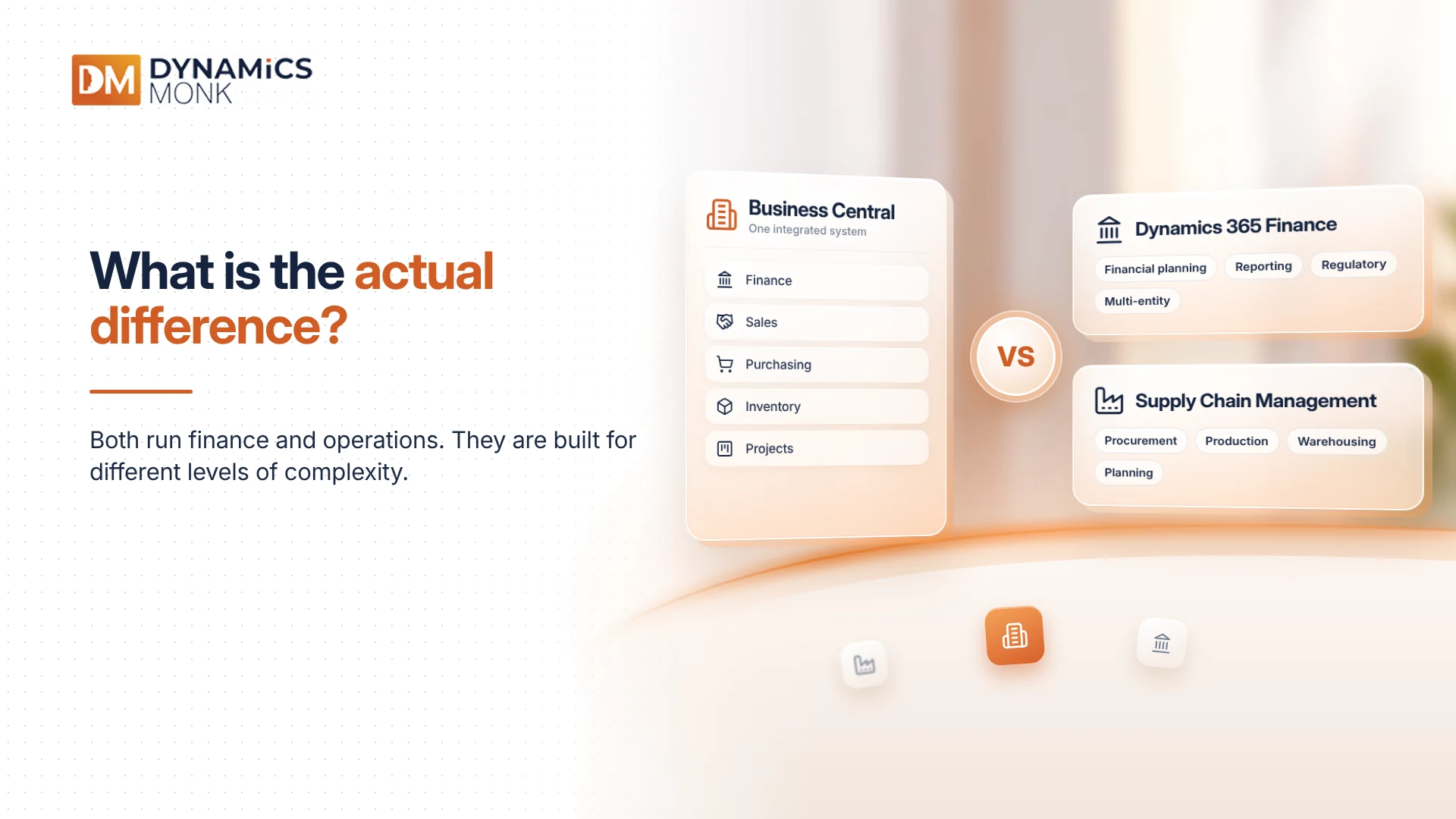
Microsoft Dynamics 365 Business Central is designed primarily for small and midsize organisations that need an integrated system for finance, sales, purchasing, inventory, projects and related business processes. Its capabilities can be extended through configuration, extensions and solutions available through Microsoft AppSource. The Premium licence adds enhanced service management and manufacturing capabilities. Microsoft's Business Central overview explains its current positioning.
Finance and Operations is a commonly used name for Microsoft's enterprise ERP applications. The current product structure separates key capabilities into Dynamics 365 Finance and Dynamics 365 Supply Chain Management, which organisations can use together depending on their requirements.
Dynamics 365 Finance focuses on financial management, financial planning, reporting, regulatory requirements and complex financial operations. Supply Chain Management supports areas such as procurement, production, inventory, warehousing, planning and logistics.
The important distinction is not that Business Central is only for small companies and Finance and Operations is only for large ones. Business Central supports multiple companies and substantial operational functionality. The enterprise applications become more relevant when the organisation's processes, operating structure or control requirements demand their deeper capabilities.
1. Who Is the ERP For: One Company or a Growing Group?
The first question is how the organisation operates today and how it expects to operate in the next few years.
A company with a central finance team, a relatively straightforward operating model and a limited number of business processes may find Business Central sufficient, even as revenue and headcount grow.
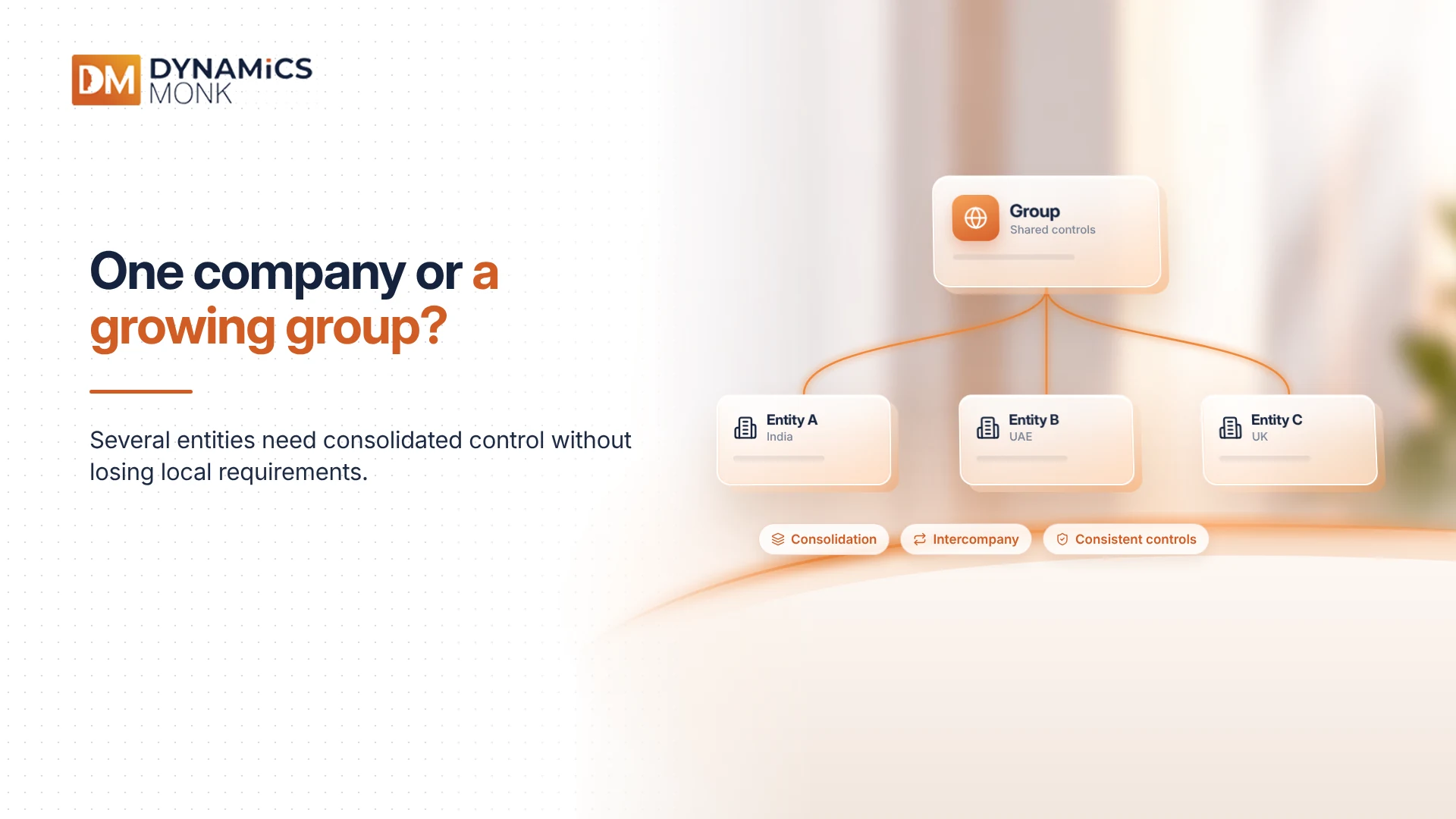
A group operating through several legal entities, countries, business units or distinct operating models may have more demanding requirements. It may need consistent financial controls across entities, consolidated reporting, intercompany transactions and standardised processes without losing the ability to manage local requirements.
Both platforms support multiple-company scenarios, but the implementation approach and available capabilities differ.
Business Central can be a good fit when the group needs a practical, integrated system with a manageable level of financial and operational complexity. Finance and Supply Chain Management deserve closer evaluation when the group needs more advanced enterprise controls, broader operational coordination or complex processes across multiple entities.
The deciding question: Does the group need to manage several companies, or does it need to coordinate a complex enterprise operating model across those companies?
2. What Does Finance Need Beyond Accounting?
Basic accounting, payables, receivables and general ledger functionality are only part of the decision.
As a group grows, finance teams may need to manage multiple currencies, intercompany transactions, group reporting, different tax and regulatory requirements, financial planning, complex allocations and faster period-end closing.
Business Central offers integrated financial management for many growing organisations. It can support multiple companies and currencies, along with reporting and processes appropriate to its scope.
Dynamics 365 Finance becomes more relevant when financial operations require deeper enterprise capabilities, more complex financial structures and broader support for global operations. Its current feature set includes financial planning and analysis, cash-flow forecasting, subscription billing, regulatory support and capabilities intended to help finance teams manage closing activities. Microsoft's Finance overview provides details of these capabilities.
For functional consultants, the important task is to map the actual finance processes before recommending a product. Questions about consolidation, intercompany settlements, local compliance, approval structures and financial dimensions should be answered during requirements discovery, not after configuration begins.
For developers, the same decisions affect data integration, reporting design, extensions and the way financial information is shared with other systems.
The deciding question: Can the group's financial requirements be met through Business Central's standard capabilities and suitable extensions, or do they call for the broader enterprise functionality of Dynamics 365 Finance?
3. How Complex Are the Supply Chain and Manufacturing Processes?
Operational complexity can be a stronger indicator than company size.
A distributor with straightforward purchasing, inventory and order fulfilment may operate effectively on Business Central. Its Premium plan also includes manufacturing and service management capabilities, making it relevant to organisations that need these functions without the full scope of an enterprise supply-chain platform.
The assessment changes when the business manages complex production planning, multiple warehouses, detailed manufacturing requirements, supplier coordination, advanced demand planning or a large network of operational dependencies.
Dynamics 365 Supply Chain Management is designed for more demanding supply-chain environments. Its capabilities cover planning, procurement, manufacturing, warehousing, transportation and asset management.
For example, a group with several manufacturing facilities may need to coordinate material availability, production schedules, inventory movements and supplier commitments across locations. The system must support the relationships between these processes, not simply record their transactions.
A growing business should therefore assess its current operational requirements alongside the next stage of expansion. Choosing a more extensive platform without a clear need can introduce unnecessary implementation effort. Choosing a platform that cannot adequately support the required operating model can lead to workarounds and additional systems.
The deciding question: Does the business need integrated core operations, or does it need advanced planning and coordination across a complex supply chain?
4. What Will the ERP Cost Beyond the Licence?
Licence pricing is important, but it does not represent the full cost of an ERP implementation.
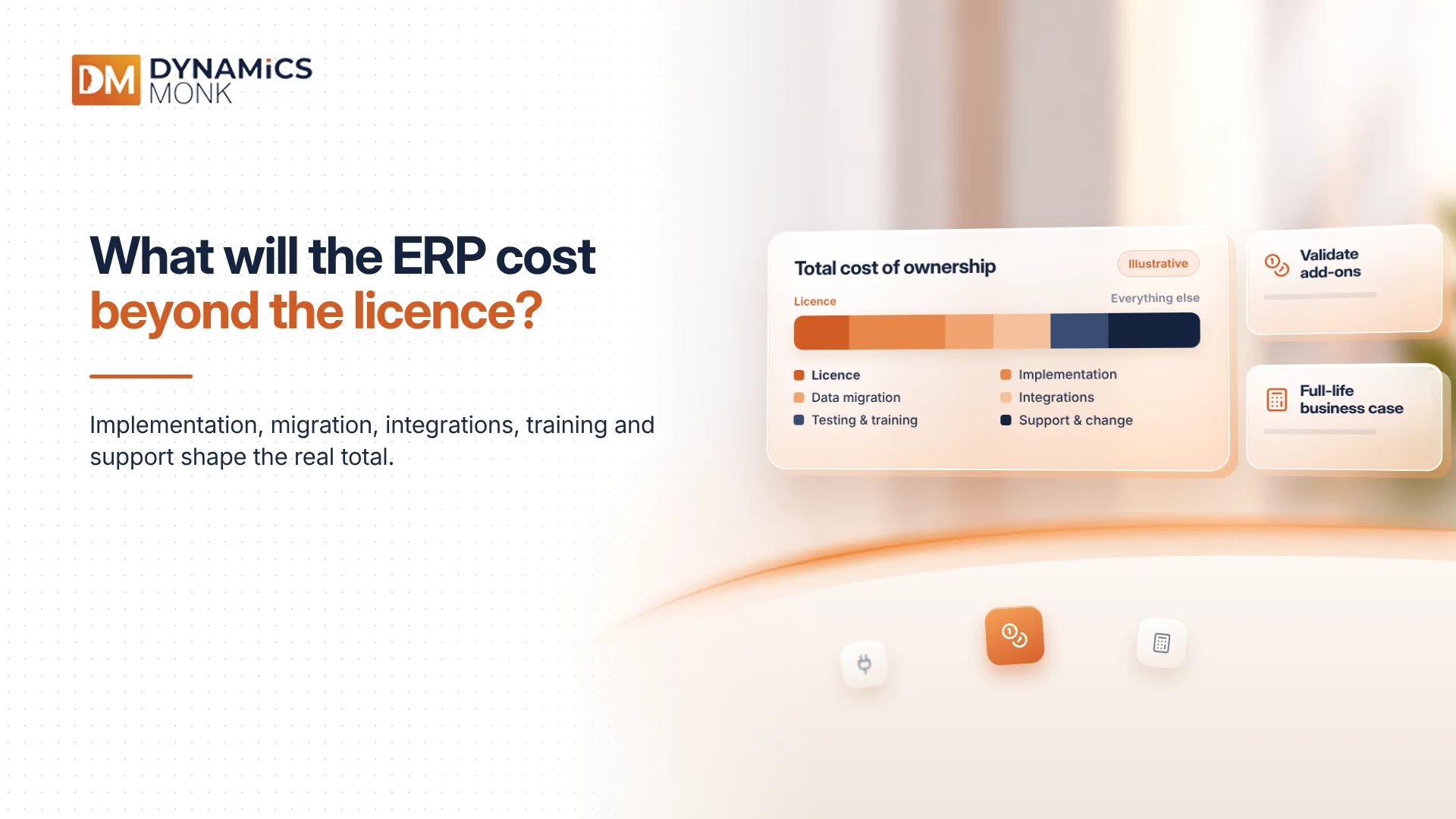
The total cost includes implementation services, configuration, data migration, integrations, custom development, testing, training, support, ongoing maintenance and future changes. Infrastructure, additional services and licensing requirements can also affect the overall investment.
Business Central generally offers a more straightforward starting point for organisations whose requirements fit its standard functionality. Its extension ecosystem can help address specific business needs without requiring every requirement to be developed from scratch.
Finance and Supply Chain Management can support more complex enterprise scenarios, but the implementation may require more detailed process design, data governance, integration planning and specialist development.
Microsoft's India pricing pages provide a useful starting point for comparison. At the time of research, Business Central Essentials was listed at ₹6,655 per user per month and Premium at ₹9,150, while Dynamics 365 Finance and Supply Chain Management were each listed at ₹17,470 per user per month for their standard plans. Prices are indicative, billed yearly, with GST extra where applicable; actual costs depend on licensing requirements and may change.
These figures should not be treated as a direct total-cost comparison. The products have different capabilities, licensing models and implementation requirements. Organisations should validate the required user licences, attach licences, add-ons, capacity and service costs before preparing a business case.
The deciding question: Which platform delivers the required capabilities at an acceptable total cost over the expected life of the solution?
5. How Much Customisation and Integration Will Be Required?
An ERP rarely operates in isolation. It may need to connect with CRM applications, e-commerce platforms, warehouse systems, banking services, reporting tools, external applications and custom business software.
Business Central supports integrations and extensions through its platform and partner ecosystem. Its AL development model allows developers to extend application functionality while keeping custom code separate from the standard application.
Finance and Operations applications have their own extensibility model, development tooling and integration patterns. Microsoft's supported approach relies on extensions rather than overlayering the standard application code. This is important because customisations must remain maintainable as Microsoft delivers application updates. Microsoft Learn's extensibility guidance explains the approach for Finance, Supply Chain and Commerce.
For technical teams, the assessment should include more than whether an integration is technically possible. They need to understand data ownership, transaction volumes, error handling, security, monitoring and the effort required to maintain the integration.
The team should also distinguish between a genuine product gap and a requirement that can be met through configuration, an existing extension or a supported integration. Unnecessary customisation increases complexity and can make future upgrades more difficult.
The deciding question: Can the required architecture be delivered through standard capabilities and supported extensions, or does the operating model need the broader enterprise platform?
6. What Has Changed in Microsoft's ERP Roadmap?
Product selection should account for the direction in which Microsoft is investing, not just the functionality available today.
Microsoft's 2026 release wave 1 introduced or planned improvements across both product families. For Business Central, the focus included AI-assisted business processes, expanded agent capabilities, developer productivity and improvements across finance, manufacturing and supply-chain operations. Microsoft Learn's Business Central release overview describes the release wave covering April to September 2026.
For Dynamics 365 Finance, Microsoft's 2026 investments included financial automation, multi-entity capabilities, improvements to financial planning and analytics, and support for additional business models such as rentals. Supply Chain Management updates included enhancements to demand planning, supplier communication and warehouse operations. Microsoft's Finance release overview and Supply Chain Management release overview provide further detail.
Another relevant change concerns how Microsoft publishes product updates. Since September 2026, Microsoft has moved away from publishing new Dynamics 365 and Power Platform release plans twice a year. New capabilities are being published through its AI at Work roadmap, while existing release plans remain available as historical references. Teams assessing an ERP should therefore review the current roadmap and product documentation rather than treating an older release plan as a complete picture of future functionality. Microsoft's release-plan guidance explains the change.
AI features are worth evaluating, but they should not determine the ERP choice on their own. Teams should assess the business process an AI capability supports, its availability, licensing requirements, data access and governance before including it in an implementation plan.
7. How Should Consultants Make the Final Decision?
A structured assessment is more useful than choosing a product based on a single measure such as revenue, user count or the number of legal entities.
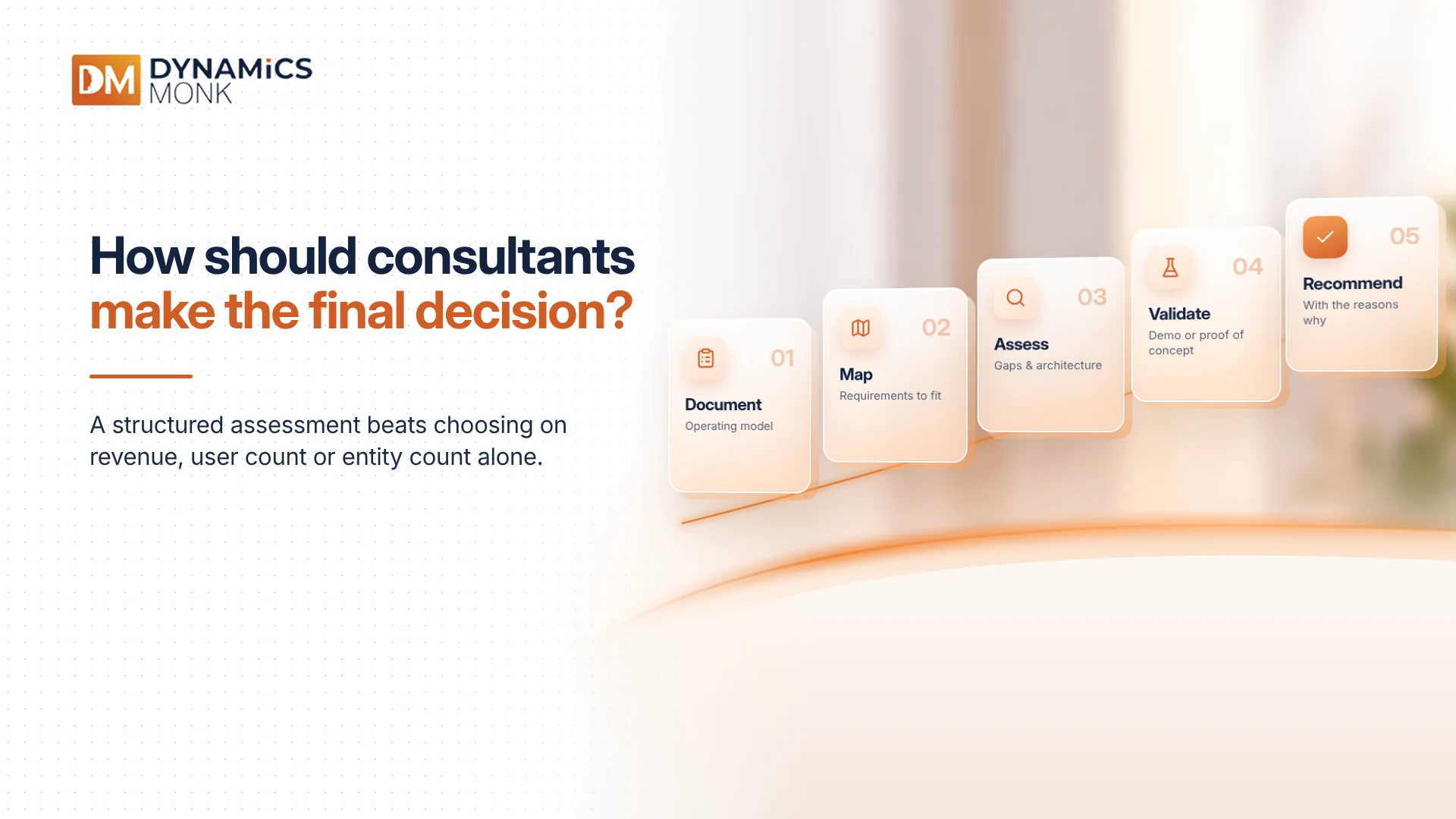
Start by documenting the group's operating model, financial requirements, supply-chain processes, reporting obligations and integration landscape. Separate current requirements from planned expansion, then identify which requirements each platform can support through standard functionality, configuration or extensions.
Next, assess the implementation implications. Functional consultants should validate business processes and identify gaps. Technical consultants should evaluate architecture and integration needs. Developers should assess extensibility, data movement and long-term maintainability. Finance and business stakeholders should compare total cost, implementation risk and expected benefits.
Finally, validate any critical requirements through demonstrations or a proof of concept. A product may appear suitable at a high level but expose important limitations when tested against the organisation's actual processes.
The recommendation should explain not only which ERP fits best, but also why the alternative is less suitable for the group's needs.
Choose for the Complexity You Need to Manage
Business Central and Dynamics 365 Finance and Supply Chain Management serve different business requirements within Microsoft's ERP portfolio. Neither should be selected simply because a company has reached a particular revenue level or number of employees.
Business Central is a strong candidate for growing organisations that need integrated finance and operations with a focused implementation scope. Finance and Supply Chain Management warrant consideration when financial structures, operational processes, global requirements or supply-chain demands call for deeper enterprise capabilities.
For Dynamics Monk, the assessment should begin with the business model, not the product name. Understand how the group operates, identify where complexity is increasing, map the requirements to Microsoft's capabilities and evaluate the long-term cost of each option.
The right ERP is the one that supports the group's next stage of growth without adding complexity the business does not need.