When an enterprise evaluates Dynamics 365, licensing discussions usually begin with the number of users, the applications they need and the features required. However, another decision can have a significant impact on the overall cost of ownership: how the organisation purchases its Microsoft subscriptions.
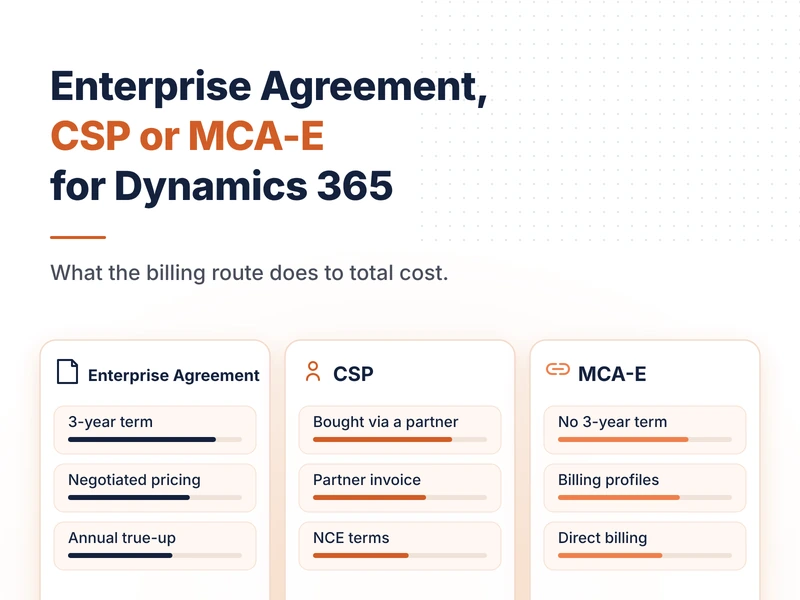
An organisation can procure Dynamics 365 through an Enterprise Agreement (EA), a Cloud Solution Provider (CSP) partner or a Microsoft Customer Agreement for Enterprise (MCA-E). Although the underlying Dynamics 365 product may be the same, the commercial structure, billing arrangements, purchasing flexibility and financial commitments can differ.
For organisations deploying Dynamics 365 Finance, Supply Chain Management or Customer Engagement applications across multiple business units, these differences deserve attention before the first subscription is purchased.
The right billing route is not necessarily the one with the lowest quoted licence price. It is the one that aligns subscription costs with actual usage, procurement requirements and the organisation's growth plans.
Understanding the Three Dynamics 365 Purchasing Routes
Before comparing costs, it is important to distinguish between a licensing model and a purchasing agreement. Dynamics 365 licensing determines what users can access and what functionality they are entitled to use. The purchasing agreement determines the commercial arrangement through which those subscriptions are acquired and billed.
1. Enterprise Agreement (EA)
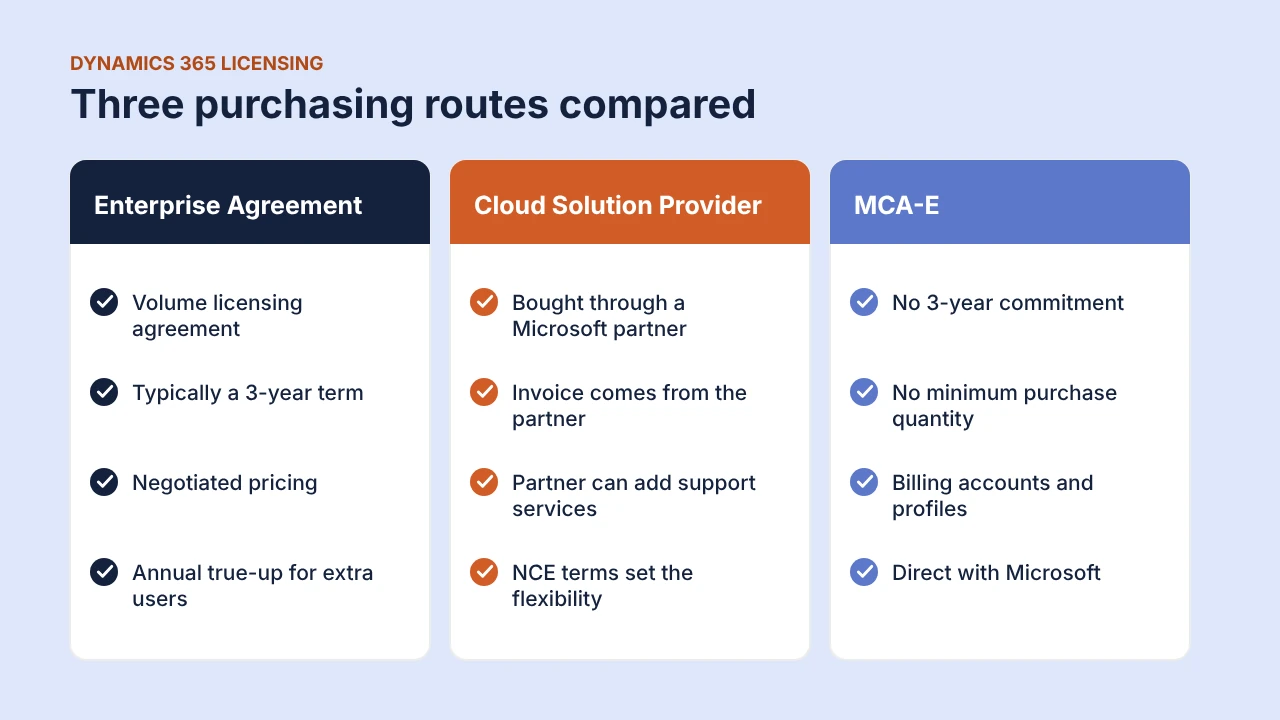
An Enterprise Agreement is a volume licensing arrangement designed primarily for larger organisations making a multi-year commitment to Microsoft technologies.
For commercial customers, the traditional EA is generally structured around a three-year term and has a minimum requirement of 500 users or devices for new agreements. It provides negotiated pricing, predictable annual payments and an established process for reconciling additional licensing requirements.
One important feature is the annual true-up process. Organisations can account for additional eligible users, devices and services during the agreement period, rather than treating every increase as a separate procurement exercise.
For an enterprise implementing Dynamics 365 across several legal entities, this structure can support centralised purchasing and financial planning.
However, a three-year commitment requires accurate forecasting. If an organisation overestimates its licensing requirements, it risks carrying costs for subscriptions that are not being fully utilised.
2. Cloud Solution Provider (CSP)
The Cloud Solution Provider programme allows organisations to purchase Microsoft cloud subscriptions through an authorised Microsoft partner.
Under this arrangement, the partner can manage subscription procurement, billing and, depending on the engagement, technical support and other services. The customer generally receives its invoice from the CSP partner rather than directly from Microsoft.
CSP is particularly relevant for organisations that want a partner involved beyond the initial licensing transaction.
Dynamics 365 subscriptions purchased through CSP are subject to the applicable subscription terms and commercial rules. Under Microsoft's New Commerce Experience (NCE), for example, subscription duration, renewal dates and cancellation conditions influence how much flexibility a customer has after purchasing.
Customers may have options involving monthly or annual billing, depending on the product, subscription term and available commercial terms. Importantly, monthly billing does not necessarily mean a monthly cancellable commitment. An annual subscription billed monthly can still carry a commitment for the full annual term.
This distinction matters when an organisation experiences changes in project scope, workforce size or implementation timelines.
3. Microsoft Customer Agreement for Enterprise (MCA-E)
The Microsoft Customer Agreement (MCA) is a cloud-focused purchasing agreement that provides a more flexible alternative to traditional volume licensing arrangements. Its enterprise purchasing route is commonly referred to as MCA-E.
Unlike the traditional Enterprise Agreement, MCA does not require a three-year purchasing commitment or a minimum purchase quantity. Organisations can acquire Microsoft cloud services, including Dynamics 365, under a streamlined agreement with flexible billing arrangements.
For enterprise customers, MCA-E offers a centralised commercial relationship with Microsoft, supported by billing accounts and billing profiles. These profiles help organisations organise subscriptions, manage invoice information and allocate financial responsibility across departments or business units.
The agreement can support direct purchasing through Microsoft. Depending on the purchasing arrangement, customers may also work with a Microsoft partner.
One consideration is that flexibility in purchasing does not automatically translate into lower subscription costs. Organisations still need to evaluate negotiated pricing, subscription terms, payment frequency and their expected consumption.
For businesses moving from an existing EA, the transition also requires attention to billing administration, subscription ownership and financial reporting. The commercial agreement may change without requiring a complete Dynamics 365 implementation or tenant migration.
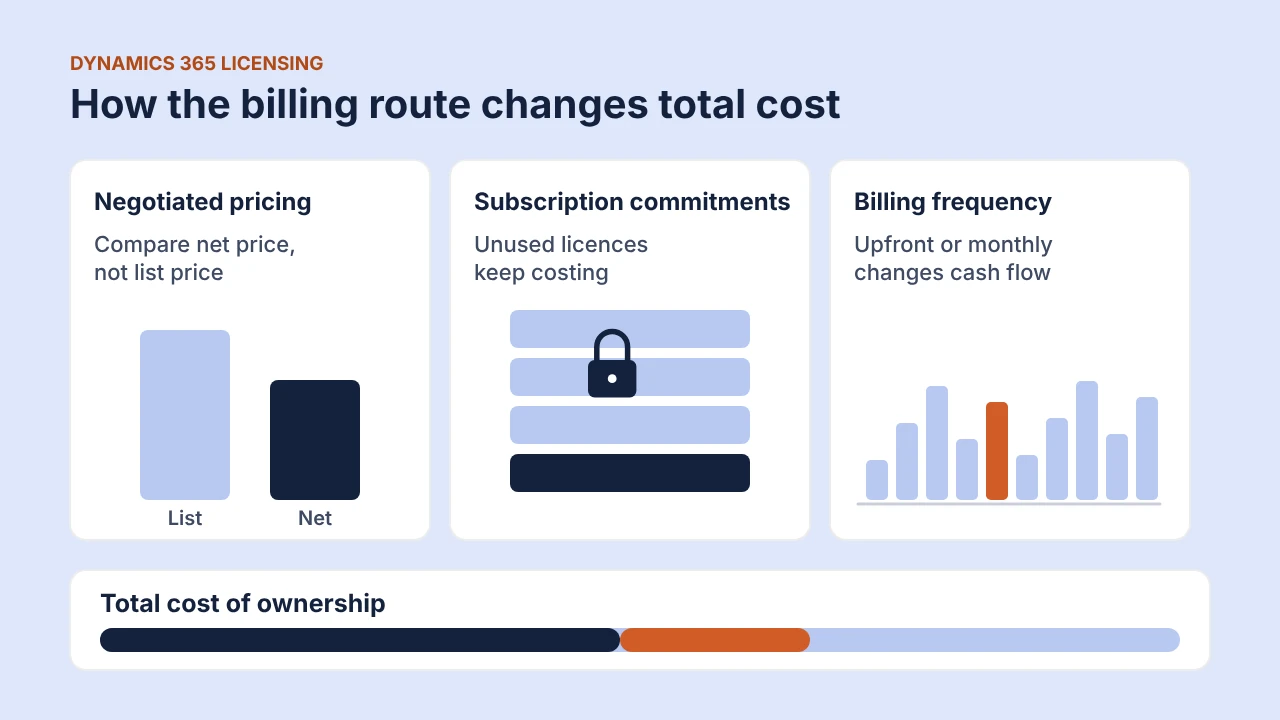
How the Billing Route Changes Total Cost of Ownership
The difference between EA, CSP and MCA-E becomes more meaningful when organisations examine the costs beyond the advertised price per user.
Several factors influence the actual financial outcome.
1. Negotiated pricing and commercial discounts
Enterprise Agreements can offer volume-based pricing and negotiated commercial terms. However, organisations should not assume that every Dynamics 365 subscription automatically receives a lower price under EA.
The final commercial benefit depends on the agreement, eligible products, negotiated discounts and applicable pricing conditions.
CSP pricing is influenced by the partner's commercial arrangement and the price offered to the customer. Partners may provide additional services, licensing guidance or bundled support, which should be evaluated separately from the subscription price.
MCA-E offers a direct commercial relationship with Microsoft for eligible enterprise customers. Pricing and discounts depend on the negotiated terms rather than simply the agreement name.
When comparing quotations, organisations should examine the actual net subscription price, not just the standard list price.
2. Subscription commitments and unused licences
Subscription duration has a direct impact on financial flexibility.
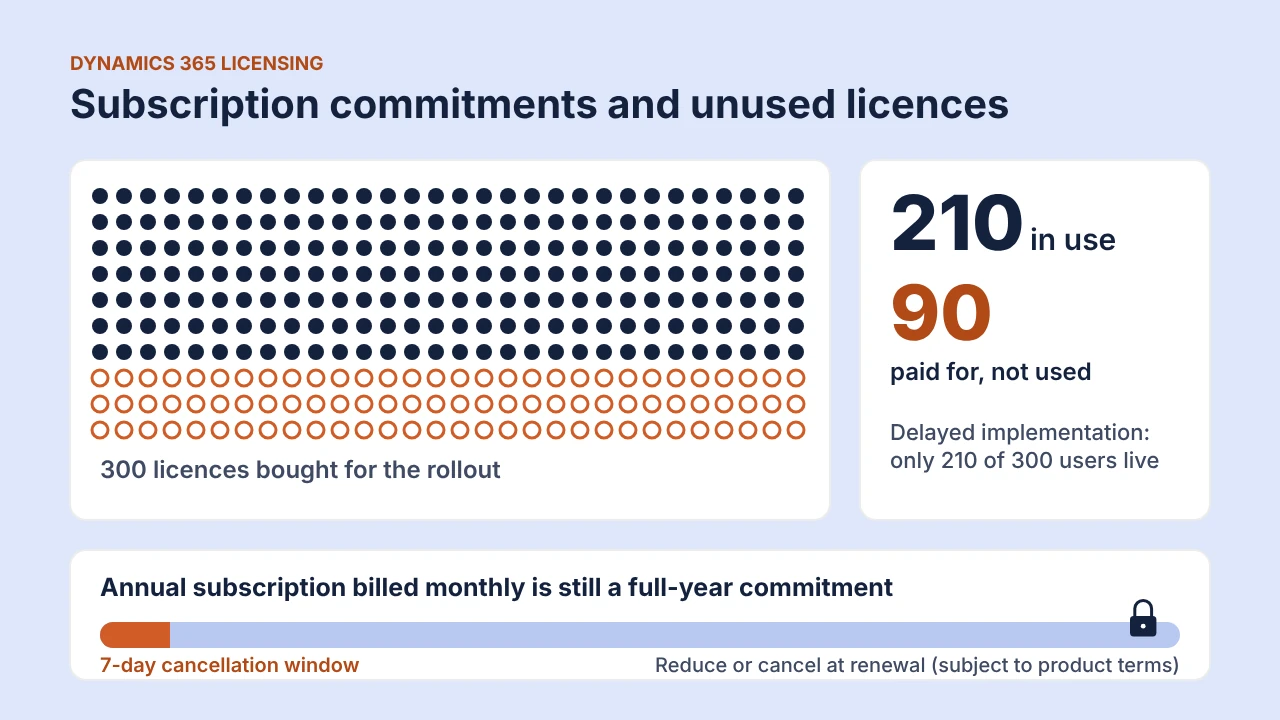
Consider an organisation implementing Dynamics 365 Finance for 300 employees. During the initial rollout, it purchases 300 user subscriptions, expecting all departments to go live within six months.
However, the implementation is delayed, and only 210 employees are actively using the system.
The organisation is now paying for 90 subscriptions that are not yet contributing to business operations.
Under CSP NCE, an annual subscription billed monthly generally remains a full-year commitment. After the applicable seven-day cancellation window, reducing or cancelling the subscription is restricted until the next renewal, subject to the applicable product terms.
A monthly-term subscription provides greater cancellation flexibility, but its commercial pricing may differ.
With MCA, organisations should review the specific subscription terms and billing arrangements before committing. Under an EA, the applicable enrollment and subscription structure determine how quantities can be adjusted.
The key consideration is to align subscription purchases with implementation milestones rather than projected headcount alone.
3. Billing frequency and cash flow
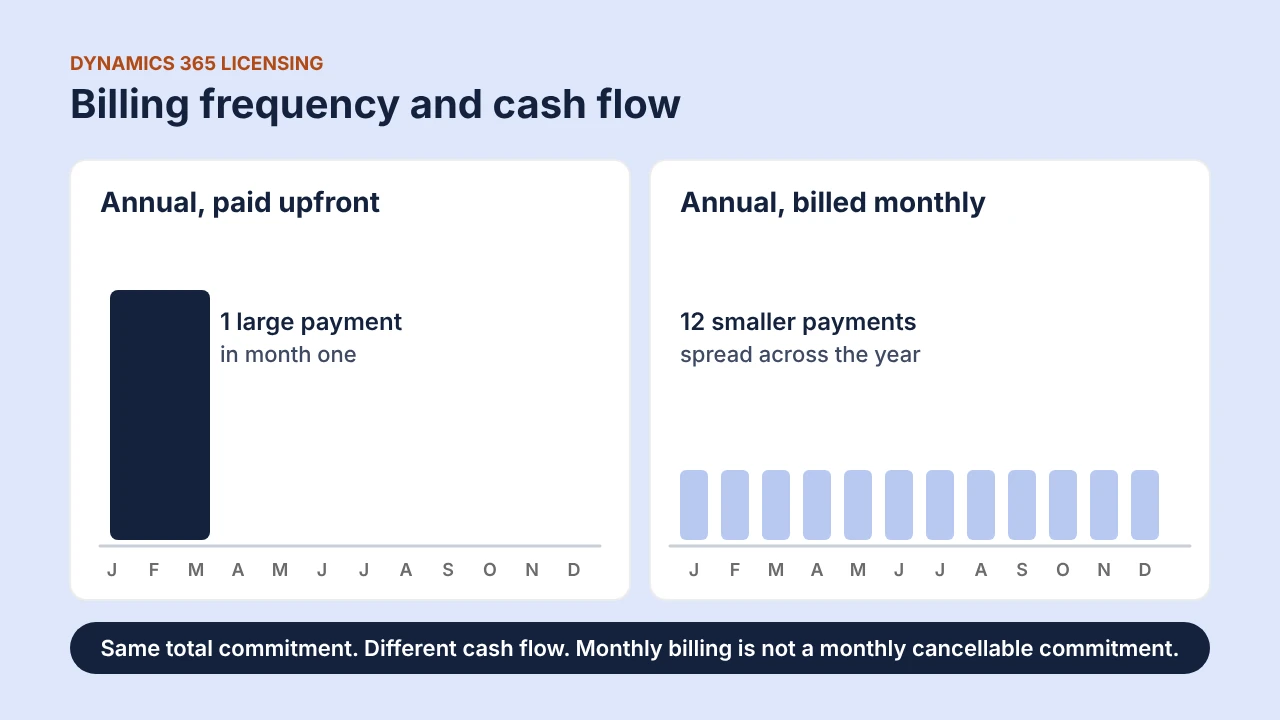
The frequency of payment can affect cash flow even when the total subscription commitment remains unchanged.
For example, an annual subscription with monthly billing distributes payments across the year. An annual subscription paid upfront requires a larger initial cash outflow.
This distinction is particularly relevant for organisations managing multiple Dynamics 365 applications.
A company deploying Finance, Supply Chain Management and Customer Service may have different implementation schedules for each application. Aligning subscription purchases and payment cycles with those schedules can improve budget management.
EA supports annual payment arrangements across its traditional three-year structure. CSP NCE offers different billing frequencies depending on the subscription term and product eligibility. MCA billing arrangements also depend on the subscription and purchasing configuration.
Finance teams should therefore evaluate both the total contractual commitment and the timing of cash outflows.
A Practical Scenario: Choosing a Billing Route for Dynamics 365
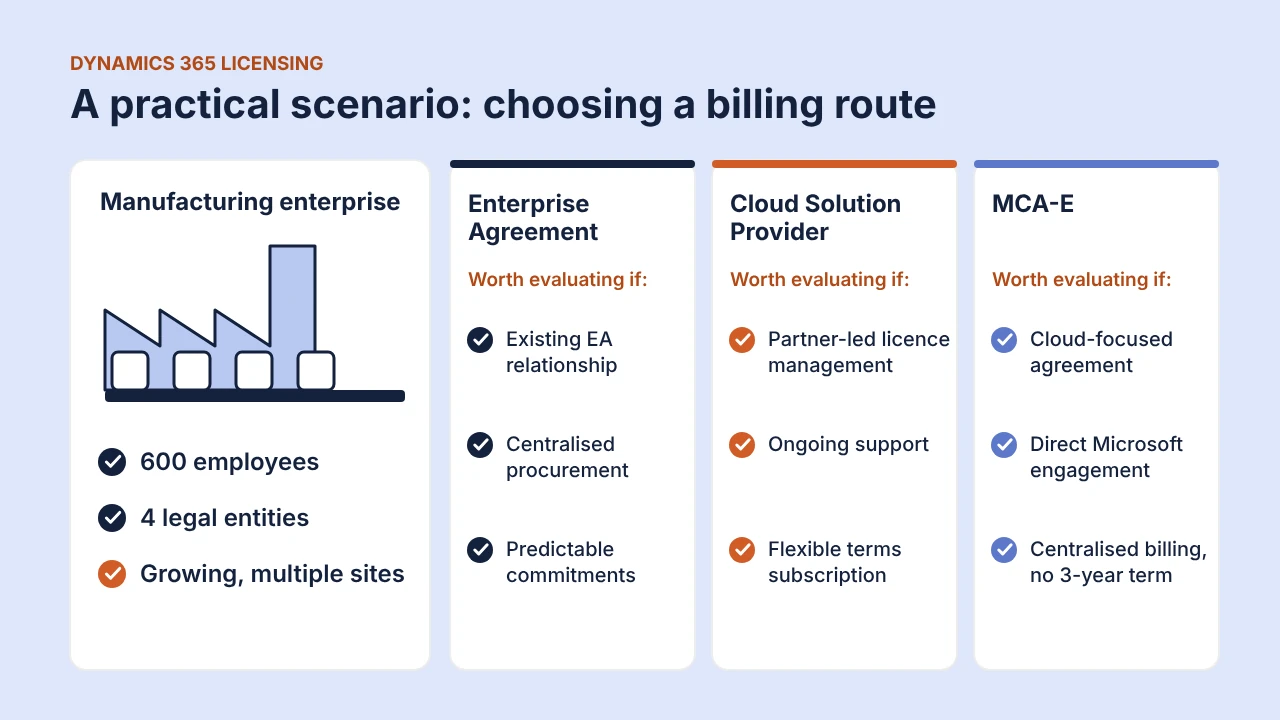
Consider a manufacturing enterprise implementing Dynamics 365 Finance and Supply Chain Management across multiple locations.
The organisation has 600 employees, operates through four legal entities and expects its workforce to expand as additional facilities become operational.
Its purchasing decision should consider the following:
- Enterprise Agreement: Worth evaluating if the organisation has an existing EA relationship, qualifies for the relevant commercial structure and can benefit from negotiated terms, predictable commitments and centralised procurement.
- CSP: Worth evaluating if the organisation requires partner-led licensing management, ongoing support and flexibility to select subscription terms that match deployment requirements.
- MCA-E: Worth evaluating if the organisation prefers a cloud-focused commercial agreement, direct Microsoft engagement and centralised billing administration without a traditional three-year EA commitment.
There is no universally cheaper option in this scenario. The result depends on negotiated pricing, subscription quantities, deployment timelines and the additional services included in each commercial proposal.
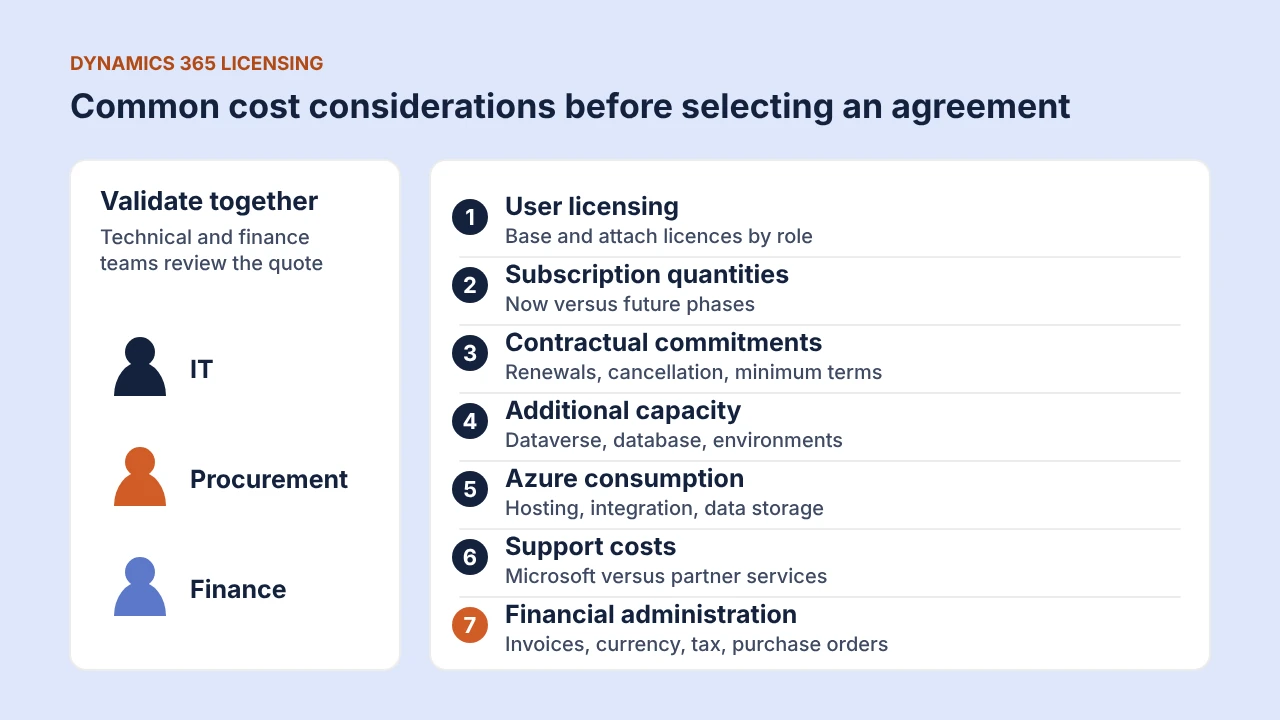
Common Cost Considerations Before Selecting an Agreement
A purchasing decision should account for more than the initial licence quotation.
Technical and finance teams should jointly validate:
- User licensing: Identify the correct base and attach licences based on actual user roles and application requirements.
- Subscription quantities: Separate immediate deployment requirements from future implementation phases.
- Contractual commitments: Review renewal dates, cancellation restrictions, minimum terms and provisions for reducing subscriptions.
- Additional capacity: Account for Dataverse storage, database capacity, environments and other applicable add-ons.
- Azure consumption: Include hosting, integration services, data storage and other consumption-based resources where applicable.
- Support costs: Distinguish Microsoft product support from partner-managed services, implementation support and ongoing administration.
- Financial administration: Review invoice consolidation, currency, tax treatment, purchase orders and internal cost allocation.
These considerations are particularly important for organisations running multiple Dynamics 365 applications alongside Power Platform and Azure services.
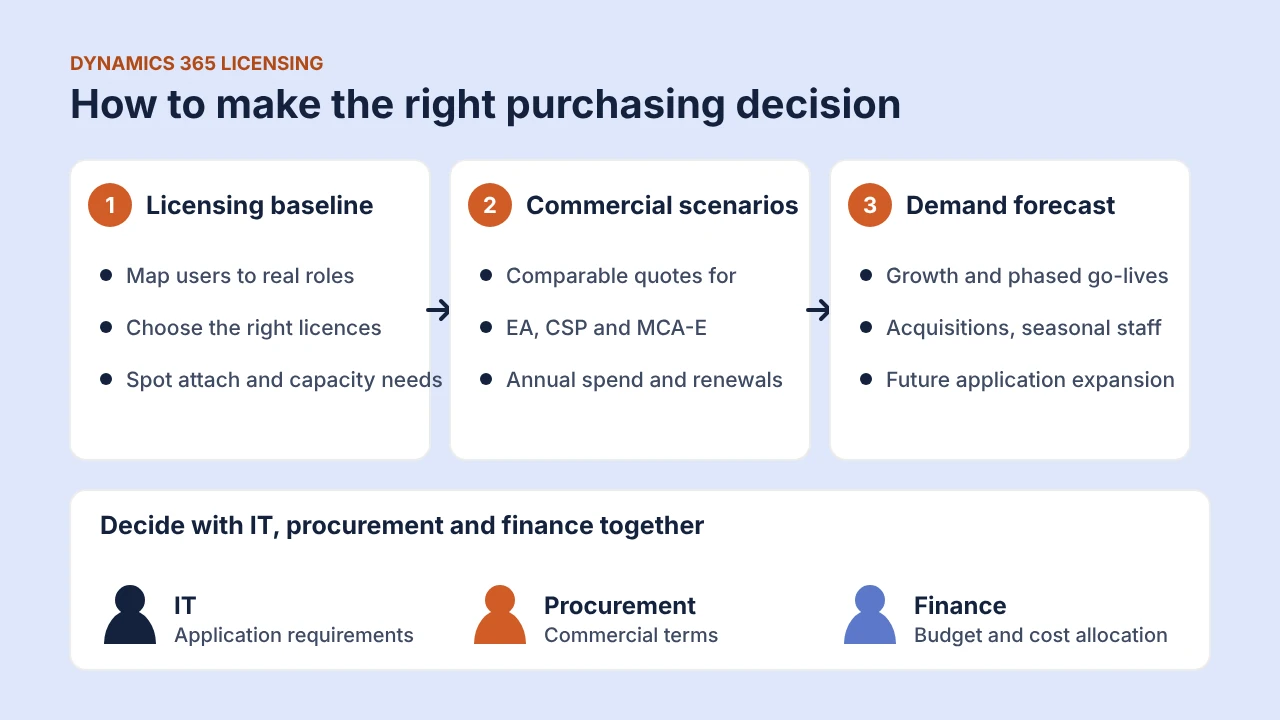
How to Make the Right Purchasing Decision
Before selecting a billing route, organisations should prepare a licensing and cost assessment covering at least the expected deployment period.
A useful assessment should include three elements.
First, establish the licensing baseline. Map users to their actual responsibilities, determine the appropriate Dynamics 365 licences and identify where attach licences or additional capacity may be applicable.
Second, model different commercial scenarios. Obtain comparable quotations for EA, CSP and MCA-E wherever the organisation is eligible. Evaluate annual expenditure, total contractual commitments, payment frequency and renewal exposure.
Third, forecast changes in demand. Account for employee growth, phased deployments, acquisitions, seasonal workforce changes and potential application expansion. A purchasing route that works for the current user count may not remain commercially appropriate three years later.
Importantly, licensing decisions should involve IT, procurement and finance teams. Technical teams understand application requirements, procurement evaluates commercial terms, and finance assesses budget commitments and cost allocation.
Conclusion
Choosing between Enterprise Agreement, CSP and MCA-E is not simply a procurement decision. It influences how an organisation commits to Microsoft subscriptions, manages billing, accommodates changing user requirements and forecasts its technology expenditure.
EA can provide commercial predictability for qualifying large organisations. CSP can introduce partner-led purchasing and licensing management. MCA-E provides a cloud-focused agreement with flexible purchasing and billing administration.
The most effective approach is to compare the total cost of the proposed licensing arrangement against actual business requirements, rather than selecting an agreement based on its headline discount.
For enterprise Dynamics 365 deployments, the right commercial structure should support the implementation roadmap, not create additional financial commitments around it.